or Powell's or me
• • •
"Mike and Jon, Jon and Mike—I've known them both for years, and, clearly, one of them is very funny. As for the other: truly one of the great hangers-on of our time."—Steve Bodow, head writer, The Daily Show
•
"Who can really judge what's funny? If humor is a subjective medium, then can there be something that is really and truly hilarious? Me. This book."—Daniel Handler, author, Adverbs, and personal representative of Lemony Snicket
•
"The good news: I thought Our Kampf was consistently hilarious. The bad news: I’m the guy who wrote Monkeybone."—Sam Hamm, screenwriter, Batman, Batman Returns, and Homecoming
May 29, 2005
The Amazing And Shocking Thing Is What People Don't Find Amazing And Shocking
Attaturk of Rising Hegemon points out this story in today's Times of London:
RAF bombing raids tried to goad Saddam into warTHE RAF and US aircraft doubled the rate at which they were dropping bombs on Iraq in 2002 in an attempt to provoke Saddam Hussein into giving the allies an excuse for war, new evidence has shown.
In a sense, of course, this shouldn't be news. In US foreign policy circles it was a given that we would carry out exactly this policy—ie, try to provoke Iraq into giving us some kind of pretext for the invasion that was going to happen no matter what.
The amazing thing is how accepted this was. For instance, The Threatening Storm by Kenneth Pollack was the book all good liberal hawks claimed had convinced them we just HAD to invade Iraq. And Pollack spoke about this strategy quite openly.
And yet as far as I can tell not a single member of the media pointed out how weird this was. (Of course, it's likely most of the people touting The Threatening Storm never bothered to read it.)
Specifically, Pollack writes about this in the "Case for an Invasion" chapter. He explains we have to invade Iraq because of Saddam's relentless pursuit of nuclear weapons. Unfortunately, other countries refuse to recognize this grave, grave danger. So in order to build as large a coalition as possible, we need some help from Iraq:

He then examines various possibilities and discards them: tying Iraq to a terrorist attack ("unfortunately, the terrorist attacks of September 11 point entirely to al-Qa'eda") and renewed weapons inspections ("as appealing as it might seem, it is a trap"). However:
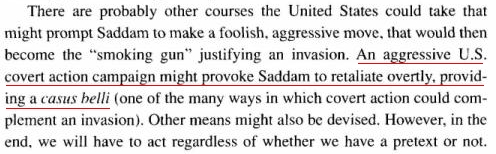
The best part is that later ON THE SAME PAGE Pollack piously explains "the administration needs to do an honest job explaining to the American people... why the United States needs to undertake this effort."
So, there you have it: we're going to invade no matter what, but we should try to come up with some pretext, all the while being honest about why we're invading. If you're capable of believing that makes any sense whatsoever, you'll be a welcome member of the US foreign policy establishment.
Posted at May 29, 2005 12:12 PM | TrackBack